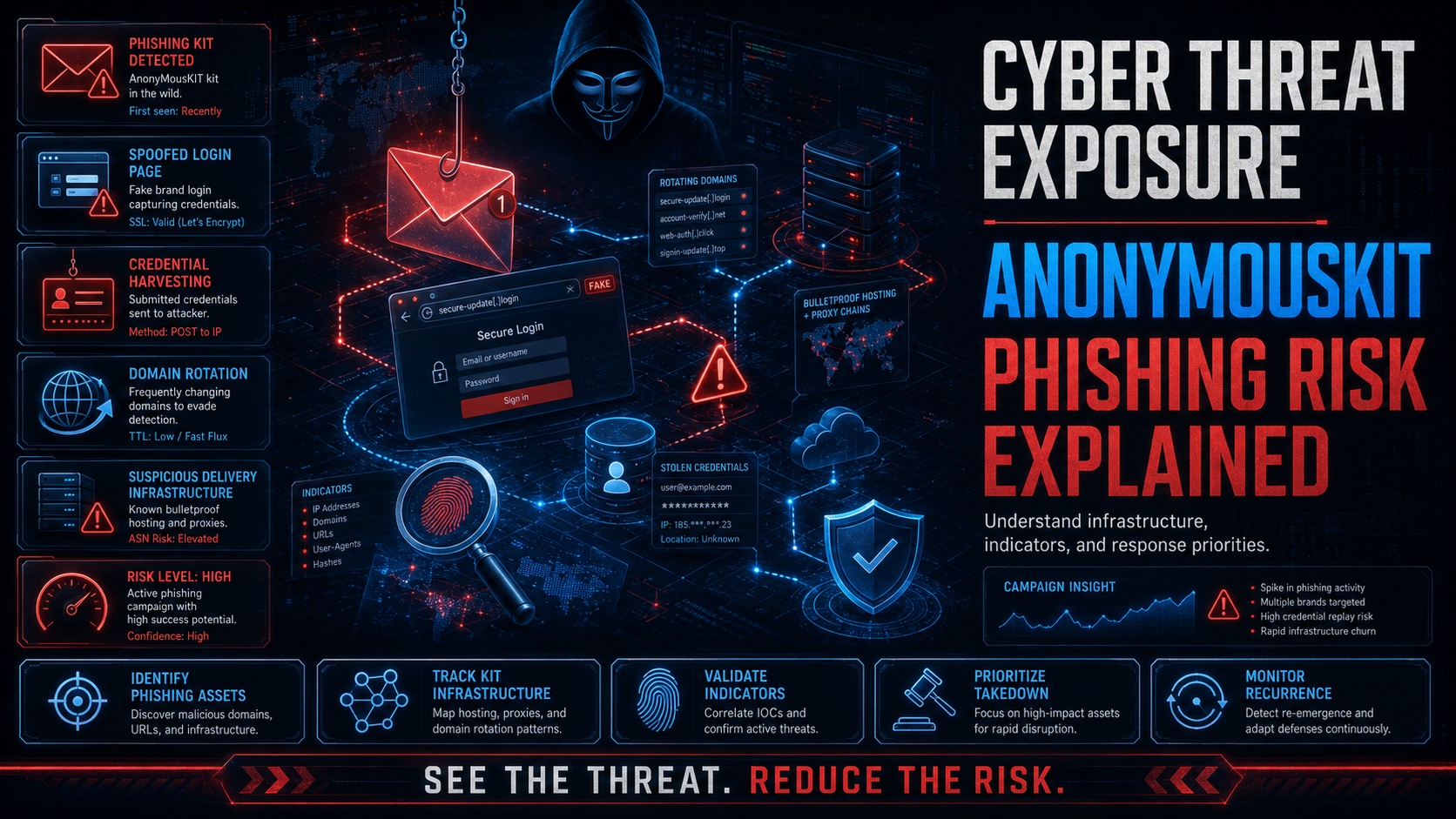
Cyber threat exposure is taking a new shape as AnonyMousKIT, a phishing-as-a-service operation documented by security researchers, automates social-engineering campaigns designed to capture Apple ID credentials, device passcodes and authentication codes. The operation reportedly combines spoofed Apple interfaces with email, SMS, WhatsApp and AI-assisted voice calls, creating a coordinated phishing workflow rather than a single malicious message.
The immediate target described in current reporting is stolen or lost Apple devices and the credentials needed to defeat their protective mechanisms. For businesses, however, the wider lesson is about identity exposure, malicious domains, social engineering and the growing ability of criminals to automate convincing multi-channel attacks.
What Is AnonyMousKIT and What Does It Do?
AnonyMousKIT is a phishing-as-a-service (PhaaS) operation that researchers at SOCRadar identified as being active since at least early 2024. Reporting by BleepingComputer and TechRadar says the service is designed around phishing Apple users, including people whose contact details become visible through Lost Mode on a missing or stolen iPhone.
According to the reporting, the operation can generate spoofed Find My or Apple-themed pages and coordinate multiple communication channels. These include email, SMS, WhatsApp and AI-generated voice interactions. The reported objective is to persuade a device owner to provide information that can ultimately help criminals remove protections from a stolen device.
SOCRadar reportedly identified more than 500 domains associated with the operation and more than 150 storefront or reseller brands. It also observed approximately 200 voice calls between August 2025 and May 2026, although those observations represent the researchers’ visibility into the operation rather than a measurement of its complete global activity.
These details make AnonyMousKIT relevant to security teams because it demonstrates how phishing infrastructure can be packaged as a service, allowing individual criminals to use capabilities that previously required more technical or operational effort.
Reference: https://gbhackers.com/anonymouskit-phaas-platform/
Why Multi-Channel Phishing Increases Cyber Threat Exposure
Traditional phishing defenses often focus heavily on email. AnonyMousKIT illustrates why that approach can leave gaps.
A victim may first receive a text message, followed by a convincing email or WhatsApp conversation, and then a phone call that reinforces the same story. When multiple channels contain consistent information, the campaign can appear more credible even though every communication originates from an attacker-controlled infrastructure.
For businesses, the risk is not limited to Apple accounts. The same operating model can be adapted to target employees, administrators, suppliers, executives or customers using other trusted brands and business workflows.
A successful social-engineering campaign can potentially expose:
- Corporate usernames and passwords
- One-time authentication codes
- Recovery information
- Employee contact details
- Device or account information
- Access to cloud services
- Privileged or administrative identities
- Information useful for follow-on impersonation
The central issue is therefore cyber threat exposure across identities, people, domains and external infrastructure rather than a single phishing URL.
Live 2FA Harvesting Shows Why MFA Alone Is Not Enough
Multi-factor authentication remains an important security control, but not every MFA method provides the same resistance to phishing.
NIST’s current Digital Identity Guidelines define phishing resistance as the ability of an authentication protocol to prevent authentication secrets or valid authenticator outputs from being disclosed to an impostor without depending on the user’s ability to recognize the attack. NIST specifically explains that manually entered one-time passwords and similar outputs are not considered phishing-resistant because attackers can potentially relay them during an active authentication session.
That distinction is directly relevant to phishing operations designed to capture authentication information in real time.
Organizations should therefore evaluate MFA implementation in context:
- Identify which systems rely on passwords plus OTPs or SMS codes.
- Prioritize privileged, administrative and high-value accounts.
- Determine whether phishing-resistant authentication is available.
- Prefer cryptographic authentication mechanisms where appropriate.
- Review account recovery processes, which can become an alternative attack path.
NIST identifies FIDO authenticators using WebAuthn as widely available examples of phishing-resistant authentication. CISA likewise recommends phishing-resistant MFA for organizational accounts and sensitive access.
How Malicious Domain Detection Can Reduce Exposure
An operation like AnonyMousKIT depends on external infrastructure that impersonates legitimate services. That makes malicious domain detection an important component of defensive exposure management.
Security teams should monitor for domains that resemble corporate brands, authentication portals, employee services or customer-facing applications. Lookalike domains do not automatically prove malicious activity, but combinations of suspicious naming, hosting characteristics, reputation signals and phishing content can justify investigation.
This is where external attack surface analysis complements traditional security controls.
A security team may already know its official domains. The harder question is what similar domains, impersonating sites and externally visible assets are being created around the brand.
ThreatExposure.io’s current reporting service describes external assessment of domains, infrastructure, applications and threat-intelligence signals, with findings organized into structured reports for security, procurement and risk teams.
For organizations evaluating cyber threat exposure, this type of external perspective can help connect malicious-domain observations with the broader digital footprint.
Cyber Threat Exposure Extends Beyond the Organization’s Own Assets
One of the most important lessons from PhaaS operations is that external risk is not confined to systems owned directly by the security team.
An organization’s exposure can also involve:
- Employees and executive identities
- Customer-facing domains
- Third-party suppliers
- Marketing and brand infrastructure
- Authentication providers
- Cloud-hosted applications
- Publicly exposed services
- Credentials appearing in breach intelligence
- Lookalike and spoofing infrastructure
This is why vulnerability exposure management should not be confused with vulnerability scanning alone. A vulnerability is a specific security weakness. Exposure management is broader and can incorporate assets, identities, configurations, reputation, threat intelligence and business context.
An externally visible domain is not automatically vulnerable. A suspicious domain is not automatically evidence of a successful attack. Likewise, an exposed credential does not by itself establish that an account was compromised.
Maintaining those distinctions is essential for accurate risk reporting.
Why Third-Party Risk Teams Should Pay Attention
PhaaS activity can create indirect supplier and customer risks when trusted relationships are used to make fraudulent communications more convincing.
Consider a business that relies on an external logistics provider, cloud application or customer-support service. If attackers impersonate that supplier, employees may be more likely to trust a message containing familiar branding or operational language.
Third-party risk teams should therefore ask:
- Which suppliers communicate directly with employees or customers?
- Which vendors handle authentication or identity workflows?
- Which suppliers have access to corporate accounts?
- Are important vendor domains monitored for impersonation?
- Could a compromised supplier identity be used in a convincing phishing pretext?
- What external evidence exists about the supplier’s cyber exposure?
A supplier’s externally visible weakness does not prove that the supplier has been compromised. Instead, it provides a reason to determine whether additional due diligence or validation is warranted.
For procurement and vendor-risk teams, a structured cyber threat exposure report can turn disparate external observations into evidence that is easier to review during onboarding, reassessment or supplier escalation.
What an External Cyber Risk Assessment Should Examine
An effective external assessment should provide context rather than simply produce a long list of technical observations.
For a business concerned about phishing-driven exposure, useful areas can include:
External domains and impersonation risk
Review the organization’s legitimate digital footprint alongside relevant domain and brand-abuse signals.
Internet-facing infrastructure
Identify externally observable assets and services that may require validation by internal security teams.
Identity and human exposure
Consider publicly visible employee information, credential exposure and other signals that could make targeted social engineering easier.
Threat intelligence
Correlate breach, reputation, leak and other intelligence signals with the organization’s known external footprint.
Risk prioritization
Separate findings that deserve immediate investigation from observations that require validation but do not independently establish compromise.
This is where an Attack Surface Management Report can be more useful to decision-makers than raw scanning output. The purpose of a report is to connect technical observations with evidence, context and remediation priorities so security and risk teams can decide what needs attention.
What Security Teams Should Do About AnonyMousKIT-Style Threats
Organizations do not need evidence that AnonyMousKIT specifically targeted them before strengthening defenses against this class of attack.
A practical response includes:
- Require phishing-resistant MFA for high-value and privileged accounts where feasible.
- Review accounts that rely on manually entered authentication codes.
- Train employees to verify support requests through trusted channels.
- Treat unexpected requests for passwords, passcodes or authentication codes as high-risk.
- Monitor corporate domains for suspicious impersonation and lookalike activity.
- Review externally exposed employee and executive information.
- Investigate reported credential exposure promptly.
- Integrate external threat intelligence with identity, email and SOC workflows.
- Include important suppliers in external cyber-risk assessments.
- Reassess high-risk vendors after significant changes or incidents.
Organizations looking for a vendor cyber risk report can use external findings as one component of broader due diligence. The report should complement, not replace, questionnaires, contractual requirements, security certifications, penetration-test evidence and direct supplier validation.
Why a Report Matters More Than Raw Exposure Data
A security scanner can produce observations. A cybersecurity report should help stakeholders understand what those observations mean.
For security analysts, that may mean evidence requiring technical investigation. For procurement teams, it may mean identifying a supplier that needs additional due diligence. For executives, it may mean a concise view of the exposures most relevant to business risk.
ThreatExposure.io currently positions its reports around structured external exposure, supplier visibility, threat intelligence, prioritization and remediation context. Its site also describes one-time and recurring reporting options for organizations that need to reassess external exposure over time.
That report-led approach is particularly relevant to cyber threat exposure because phishing infrastructure changes quickly. A point-in-time finding should be treated as evidence for a decision, not as a permanent statement about an organization’s security posture.
Frequently Asked Questions
Is AnonyMousKIT a malware family?
No. Current reporting describes AnonyMousKIT as a phishing-as-a-service operation rather than a conventional malware family. Its reported functionality centers on phishing infrastructure, social engineering, spoofed pages and AI-assisted voice interactions designed to obtain information from victims.
Does MFA stop AnonyMousKIT-style phishing?
MFA can substantially improve account security, but the protection depends on the authentication method. NIST explains that some manually entered authentication outputs remain susceptible to phishing and relay attacks. Phishing-resistant mechanisms such as FIDO/WebAuthn provide stronger protection against this class of attack.
Is a suspicious lookalike domain proof that a company was attacked?
No. A suspicious or impersonating domain is an external exposure indicator, not proof of compromise. Security teams should validate the domain, assess its relationship to the legitimate brand, determine whether it is being used maliciously, and document evidence before treating it as an incident.
Can an external cyber risk report replace a phishing assessment?
No. An external cyber risk report provides a different perspective. It can identify externally observable assets, threat-intelligence signals and other exposure indicators, while phishing assessments and security-awareness exercises evaluate how users respond to simulated social-engineering scenarios. Organizations may benefit from using both approaches.
Get a Cyber Exposure Report for External Risk Decisions
Get a structured cyber exposure report from ThreatExposure.io NOW — empowering security, procurement, and vendor‑risk teams to transform external findings into clear, actionable evidence for investigation, remediation, and risk decisions.
Disclaimer: Threatexposure reports on publicly available threat-intelligence sources. Inclusion of an organization in an article does not imply confirmed compromise. All claims are attributed to external sources unless explicitly verified.
Leave a Reply