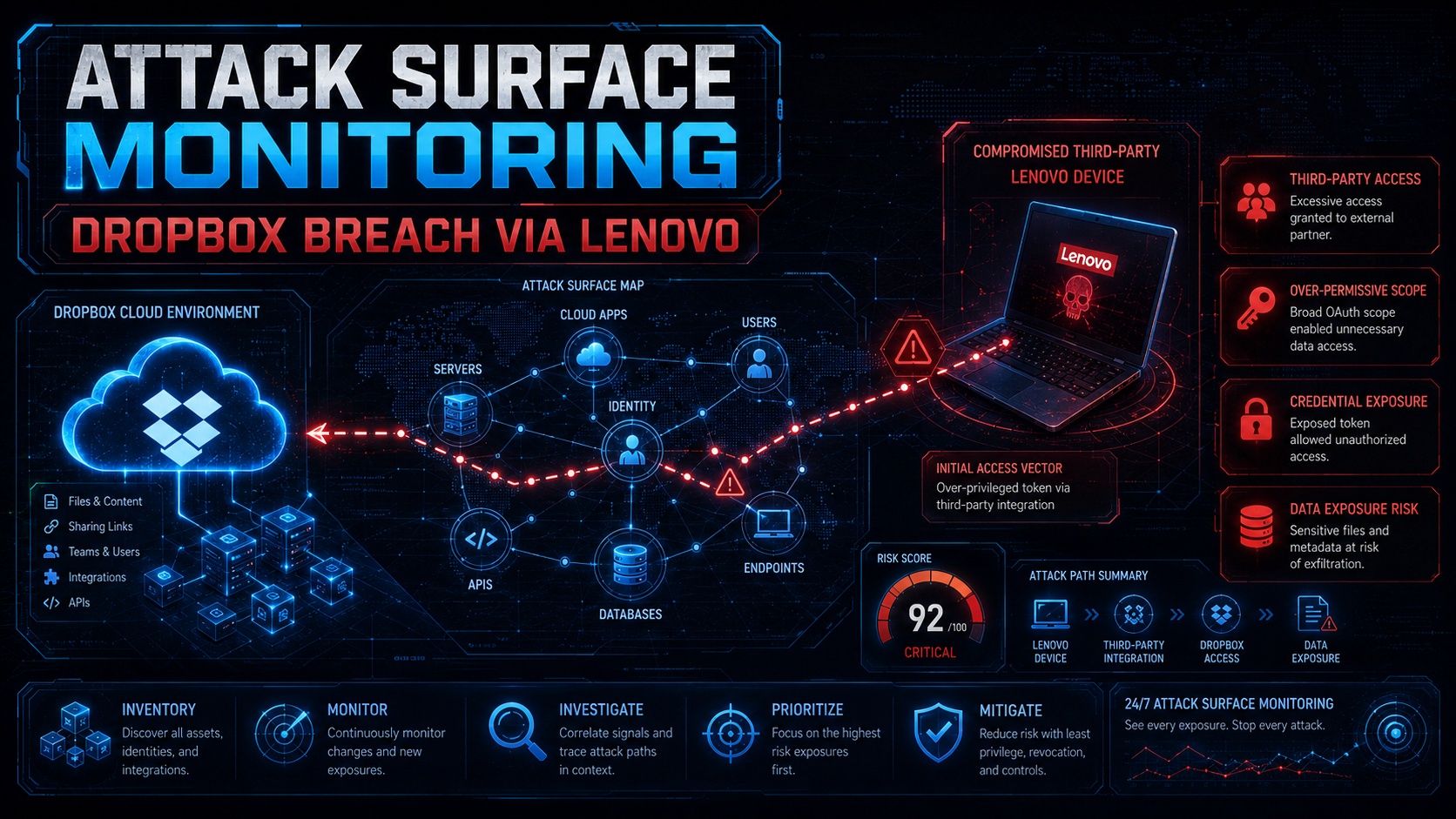
Attack surface monitoring has become increasingly relevant as organizations rely on third-party identity providers, cloud services, and interconnected authentication systems. The Dropbox incident involving a flaw in Lenovo’s email verification process demonstrates why security teams cannot assess third-party risk solely by reviewing a vendor questionnaire or internal infrastructure.
Dropbox said unauthorized parties accessed accounts between August 4 and August 21, 2026, after exploiting an issue in Lenovo’s email verification process to create Lenovo IDs using other people’s email addresses. Reuters later reported that approximately 5,000 Dropbox accounts were compromised, with files accessed in fewer than one-third of those accounts.
For security, procurement, and third-party risk teams, the incident is a useful case study in identity federation, supplier dependencies, and the difference between a vendor’s visible attack surface and the security of the trust relationships surrounding it.
What Happened in the Dropbox-Lenovo Incident?
Dropbox uses Lenovo Identity Provider Services as part of an authentication pathway that allows users to sign into Dropbox using verified Lenovo IDs. According to Dropbox’s investigation, a weakness in Lenovo’s email verification process allowed an unauthorized party to register a Lenovo ID using an email address they did not control.
The fraudulent Lenovo identity could then be used to access the Dropbox account associated with the same email address without entering the Dropbox password.
Lenovo described the issue to BleepingComputer as involving a legacy integration between Lenovo ID and Dropbox that could be used to improperly authenticate certain Dropbox accounts. Lenovo also said its own customers were not affected by the issue and that the investigation remained ongoing.
Dropbox responded by expiring sessions authenticated through Lenovo IDs, removing the links between Lenovo IDs and Dropbox accounts, and requiring users to enter their Dropbox password when attempting to access an account through Lenovo authentication.
This is not simply a story about one defective verification workflow. It highlights how authentication dependencies can create risk across organizational boundaries.
Why Federated Identity Can Become a Third-Party Risk
Federated authentication allows one identity provider to authenticate a user for another service. This model is widely used because it reduces password management and simplifies access across connected services.
The security assumption is straightforward: the relying party trusts the identity provider’s authentication assertion. If the identity provider incorrectly establishes ownership of an identity, however, the relying party may receive an assertion that appears legitimate but represents the wrong person.
NIST’s current Digital Identity Guidelines specifically address federation and assertions, emphasizing that relying parties should process and verify valid assertions and ensure that the assertion comes from the expected identity provider and is appropriately associated with the subscriber account.
The Dropbox incident illustrates why this matters for third-party risk management. A supplier does not need direct access to a customer’s database to create meaningful risk. A weakness in a trusted identity relationship can potentially affect the security boundary of another organization.
What This Means for Vendor Cyber Risk Assessments
A traditional vendor security assessment often asks whether a supplier has MFA, vulnerability management, incident response, encryption, certifications, and other controls.
Those questions remain useful, but they do not necessarily reveal how the supplier connects to external services.
A stronger vendor cyber risk report should encourage organizations to consider questions such as:
- Which identity providers or external authentication services does the supplier depend on?
- Which third parties are trusted to authenticate users?
- How are new federated identities linked to existing accounts?
- What controls protect account-linking and recovery processes?
- What happens if a trusted identity provider makes an incorrect assertion?
- How quickly can federated sessions be revoked?
- Are legacy integrations still required?
- Are critical authentication relationships periodically reviewed?
This does not mean every supplier using SSO represents elevated risk. It means the architecture and trust relationships should be evaluated according to business criticality and the sensitivity of the services involved.
How Attack Surface Monitoring Reveals External Risk
Attack surface monitoring traditionally focuses on what an organization exposes externally, including domains, subdomains, IP infrastructure, applications, services, certificates, and other internet-visible assets.
But external exposure is broader than a list of IP addresses.
Third-party authentication, SaaS integrations, vendor-managed applications, public-facing APIs, and externally dependent services can form part of the effective security boundary. An organization may therefore have a relatively well-controlled infrastructure while still depending on external systems that influence authentication or access.
This is where attack surface monitoring can complement traditional vulnerability management. Vulnerability exposure management focuses on identifying and addressing weaknesses, while attack surface assessment helps establish what assets and dependencies are visible and relevant in the first place.
For example, an assessment might identify an externally visible application or service associated with a supplier. That finding does not prove the application is vulnerable or compromised. It provides context that security teams can investigate further.
ThreatExposure.io describes its reporting approach as correlating infrastructure, applications, identities, and threat intelligence into structured external exposure reporting. Its current site also identifies attack surface mapping, infrastructure analysis, application observations, identity exposure, and threat intelligence as components of its reporting workflow.
External Exposure Is Not the Same as Exploitation
The Dropbox incident is also a useful reminder to maintain precise terminology.
An external asset is something observable from outside an organization’s environment.
An exposure is a condition that may increase risk, such as unnecessary internet accessibility or an externally visible service.
A vulnerability is a security weakness that can potentially be exploited.
Exploitation means that an attacker actually used a vulnerability or weakness.
Compromise means there is evidence that unauthorized access or control occurred.
These categories should not be collapsed into one another.
A Third-Party Risk Management Report or ASM Report should therefore give stakeholders enough context to distinguish between discovery, exposure, vulnerability, exploitation, and confirmed compromise.
That distinction becomes particularly important when procurement teams use external security intelligence to evaluate suppliers.
Why Point-in-Time Vendor Reviews Can Miss Identity Risk
A supplier can change its authentication architecture, SaaS dependencies, domains, applications, or externally exposed infrastructure after completing a security questionnaire.
Likewise, a legacy integration can remain operational long after its original business purpose has changed.
This creates security posture drift.
For critical suppliers, periodic external assessment can provide a second perspective alongside contractual reviews and questionnaires. The objective is not to declare that a supplier is “secure” or “insecure,” but to identify externally observable conditions that deserve validation.
ThreatExposure.io’s current reporting model includes comparison logic for assessing changes between scans and describes recurring reporting as an option for continuous assurance.
For organizations managing large supplier portfolios, this can help create a more structured process for identifying which vendors require deeper investigation.
How Human Risk Management Fits Into the Picture
The Dropbox incident also demonstrates that identity security is not exclusively a technical infrastructure problem.
Users, administrators, procurement teams, and vendor managers all interact with authentication systems. Unexpected SSO options, unfamiliar account-linking prompts, suspicious login notifications, or changes to authentication behavior can become important signals.
This is where Human Risk Management intersects with third-party security.
Employees should know how legitimate authentication prompts appear and where to report unexpected changes. Security teams should also ensure that users understand the implications of approving new identity providers, applications, or authentication connections.
Training cannot compensate for a defective identity architecture, but informed users can provide an additional detection layer when unusual authentication behavior appears.
What Security and TPRM Teams Should Do Now
Organizations using Dropbox, Lenovo ID, or comparable federated identity arrangements should consider the following:
- Inventory identity dependencies. Document external identity providers, SSO relationships, authentication brokers, and account-linking mechanisms.
- Review privileged and sensitive accounts. Prioritize administrators, executives, developers, finance users, and accounts containing sensitive business information.
- Audit authentication activity. Investigate unexpected sessions, unfamiliar authentication methods, unusual locations, and newly linked applications or identity providers.
- Validate MFA coverage. Dropbox told Reuters that the affected accounts were linked to Lenovo ID and did not have two-factor authentication enabled.
- Review legacy integrations. Remove authentication relationships that no longer have a clear business requirement.
- Assess critical suppliers externally. Review domains, applications, infrastructure, identity dependencies, and threat-intelligence indicators associated with important vendors.
- Document evidence and remediation. Findings should be traceable so procurement, security, and vendor-management teams can communicate clearly with suppliers.
How a Third-Party Risk Management Report Supports Decisions
Raw security observations are useful to analysts, but procurement and executive stakeholders often need something more structured.
A Third-Party Risk Management Report can turn individual external findings into a decision-oriented assessment. The practical value is helping stakeholders understand which observations matter, what requires validation, which suppliers deserve greater scrutiny, and what remediation should be discussed with the vendor.
This distinction separates raw security data from a usable cybersecurity report.
For example:
| Raw observation | Decision-oriented question |
| External service identified | Does the supplier require validation? |
| Authentication dependency observed | Is the identity relationship business-critical? |
| Security weakness identified | What evidence should the vendor provide? |
| Threat intelligence finding | Does the supplier require escalation? |
| Multiple exposures | Which issue should be addressed first? |
ThreatExposure.io positions its reports for security, procurement, governance, and supply-chain teams, with vendor-specific findings, evidence, prioritization, and remediation context.
A structured report does not replace questionnaires, SOC reports, penetration tests, certifications, contractual requirements, or internal assessments. Instead, it can provide an additional external evidence layer for supplier due diligence.
Why ASM Reports Matter in Third-Party Due Diligence
An ASM Report can be particularly useful when an organization needs to understand the external footprint of a vendor before onboarding, renewing a contract, or reassessing a critical supplier.
The goal is not simply to produce a larger list of technical findings. Effective reporting should help answer business questions.
For a procurement team, that might mean determining whether a supplier warrants additional security review.
For a CISO, it could mean identifying external exposures that require technical validation.
For a vendor-risk manager, it may provide evidence to support a remediation request.
For executives, it can provide a concise picture of external cyber exposure without requiring them to interpret raw infrastructure data.
ThreatExposure.io currently offers one-time reports as well as broader full-report options and recurring reporting, making the report itself the primary deliverable rather than treating raw monitoring data as the end product.
Security Checklist for Critical Vendors
Organizations reviewing third-party authentication and external exposure should:
- Map critical supplier dependencies.
- Identify external identity providers and SSO relationships.
- Review legacy authentication integrations.
- Validate MFA for sensitive accounts.
- Audit suspicious authentication events.
- Inventory supplier-facing domains and applications.
- Distinguish exposure from confirmed vulnerability.
- Investigate relevant vulnerability intelligence.
- Review breach and credential exposure where appropriate.
- Prioritize suppliers according to business impact.
- Document evidence for vendor remediation discussions.
- Reassess critical suppliers after major architectural changes.
Frequently Asked Questions
Was Dropbox directly vulnerable?
The incident was linked to a flaw in Lenovo’s email verification process and a legacy Lenovo ID integration with Dropbox. Dropbox’s investigation determined that fraudulent Lenovo IDs could be used to access associated Dropbox accounts. The incident therefore involved a cross-service authentication trust relationship rather than a conventional vulnerability in Dropbox file storage itself.
What is attack surface monitoring?
Attack surface monitoring is the ongoing assessment of an organization’s externally observable digital footprint. It can include domains, subdomains, infrastructure, applications, services, and other exposed assets. For third-party risk, the same approach can provide additional context about a supplier’s external exposure, although visibility into an asset does not by itself prove vulnerability or compromise.
Can an ASM Report prove that a vendor was breached?
No. An ASM Report can document externally observable exposure and provide evidence for further investigation, but external exposure does not automatically establish exploitation or compromise. A confirmed breach generally requires reliable evidence such as verified incident reporting, forensic findings, or an official disclosure. This distinction is essential when using external assessments for procurement or risk decisions.
How does third-party identity risk affect vendor due diligence?
Third-party identity risk can extend beyond the supplier’s own infrastructure because authentication relationships may influence access to connected services. Due diligence should therefore consider important identity providers, SSO dependencies, account-linking controls, legacy integrations, and the process for revoking trusted sessions, alongside conventional security controls.
Get an Attack Surface Management Report
The Dropbox-Lenovo incident shows why third-party cyber risk cannot be reduced to a questionnaire or a vulnerability list. Organizations need evidence about what suppliers expose externally and how those findings could affect business decisions. A structured Attack Surface Management Report can help security, procurement, and vendor-risk teams turn external observations into prioritized findings and remediation discussions. Review ThreatExposure.io’s current reporting options
For broader analysis of emerging exposure-management issues, read the ThreatExposure.io cybersecurity research and insights. A report can complement, rather than replace, supplier questionnaires, certifications, penetration testing, contractual controls, and internal security assessments.
Disclaimer: Threatexposure reports on publicly available threat-intelligence sources. Inclusion of an organization in an article does not imply confirmed compromise. All claims are attributed to external sources unless explicitly verified.
Leave a Reply