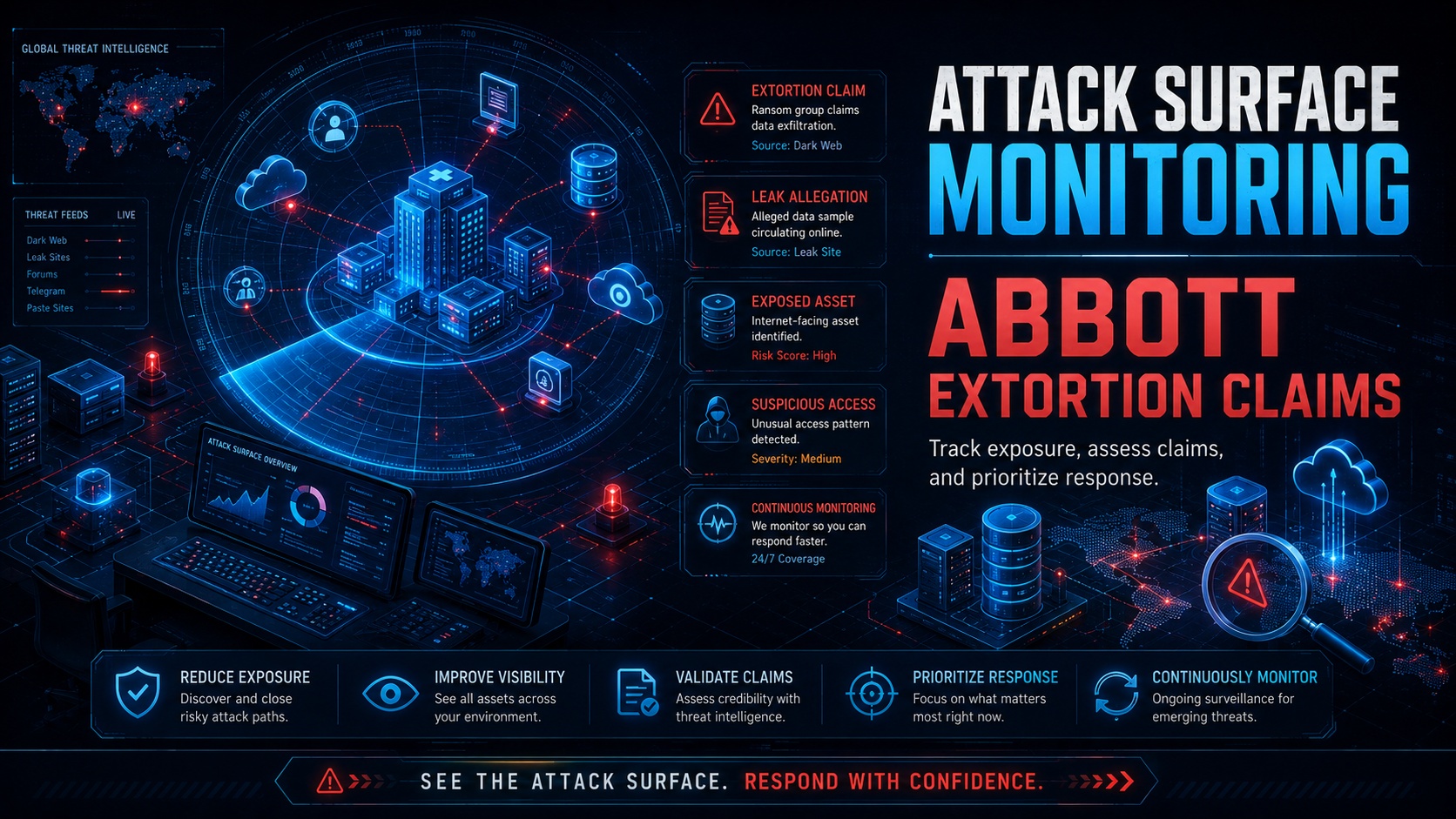
Abbott Laboratories, one of the world’s largest healthcare companies, is investigating two separate cybersecurity incidents following claims by an extortion group that it had stolen sensitive company data. While Abbott has not confirmed that customer or patient information was compromised, the incidents highlight how modern organizations face increasing risks from ransomware operators, data theft groups, and sophisticated cybercriminals. 🔍
The situation demonstrates why attack surface monitoring has become an essential part of enterprise cybersecurity. Organizations with large digital infrastructures—including healthcare providers, manufacturers, and multinational corporations—must continuously identify exposed assets before attackers exploit them. As cyber extortion continues to evolve, proactive visibility across internet-facing systems is becoming just as important as traditional endpoint protection.
Understanding the Abbott Cyber Incidents
According to reports, Abbott is investigating two separate cybersecurity events after an extortion group claimed responsibility for obtaining company data. The attackers allegedly listed Abbott on their leak site, a common tactic used to pressure organizations into paying ransom demands after refusing negotiations.
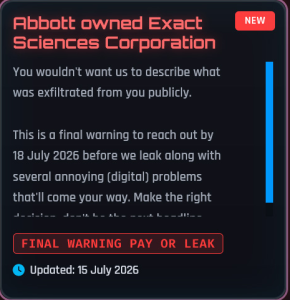
At the time of reporting, Abbott stated that it is actively investigating the claims and assessing the potential scope of the incidents. The company has not publicly confirmed whether the leaked information is authentic or whether any operational systems were affected.
Healthcare organizations remain attractive targets because they store valuable personal, financial, research, and operational information. Criminal groups often believe these organizations are more likely to pay ransom demands due to the critical nature of healthcare services. 🏥
According to BleepingComputer, Abbott is working with cybersecurity experts to investigate the incidents while monitoring any potential impact on its operations and stakeholders.
Why Healthcare Organizations Are Frequent Targets
The healthcare industry continues to experience one of the highest rates of cyberattacks worldwide. Attackers value healthcare organizations because they often possess:
- Personally identifiable information (PII)
- Medical records
- Financial information
- Intellectual property
- Research data
- Supply chain information
Unlike many other industries, healthcare organizations must maintain continuous availability of critical services. Any disruption may directly impact patient care, making ransomware and extortion particularly effective.
Large enterprises like Abbott also maintain thousands of internet-facing systems distributed across multiple countries, subsidiaries, cloud environments, and business units. Without continuous attack surface monitoring, identifying every exposed asset becomes increasingly difficult.
How Attack Surface Monitoring Reduces Risk
Modern enterprises constantly introduce new digital assets through cloud deployments, acquisitions, remote work infrastructure, APIs, and third-party integrations.
Attack surface monitoring provides continuous visibility into these external assets by identifying:
| External Asset | Security Benefit |
| Public IP addresses | Detect exposed services |
| Web applications | Identify vulnerabilities |
| Cloud resources | Reduce cloud exposure |
| Domains & subdomains | Monitor unauthorized assets |
| SSL certificates | Detect misconfigurations |
| Open ports | Minimize unnecessary exposure |
| Shadow IT | Discover unknown systems |
Rather than waiting for attackers to discover exposed infrastructure first, organizations can identify and remediate weaknesses proactively. ✅
Extortion Groups Are Changing Their Tactics
Today’s ransomware groups increasingly operate as data extortion organizations rather than encryption-only attackers.
Their common workflow includes:
- Gain initial access.
- Escalate privileges.
- Steal sensitive information.
- Threaten public disclosure.
- Demand payment.
Even when ransomware is never deployed, stolen information alone becomes leverage against victims.
Many organizations now prioritize cloud attack surface management because attackers frequently exploit exposed cloud storage, identity services, remote access systems, and misconfigured infrastructure.
Why Continuous Visibility Matters
Traditional vulnerability scanning provides only periodic snapshots.
In contrast, continuous attack surface monitoring delivers ongoing visibility as new assets appear or configurations change.
This continuous approach enables security teams to:
- Detect newly exposed systems
- Identify forgotten assets
- Monitor cloud environments
- Discover vulnerable services
- Track third-party exposure
- Prioritize remediation efforts
As organizations increasingly adopt hybrid cloud environments, cloud attack surface management becomes essential for maintaining security across multiple providers and business units. ☁️
Could This Incident Have Been Prevented?
No cybersecurity program can guarantee prevention of every attack.
However, organizations that combine proactive exposure management with rapid detection significantly reduce both the likelihood and impact of successful attacks.
A mature security strategy includes:
- Asset discovery
- Vulnerability management
- Threat intelligence
- Incident response
- Security awareness
- Continuous monitoring
These layers work together to reduce opportunities for attackers before they escalate access.
Practical Checklist for Reducing Cyber Exposure
Security leaders can strengthen resilience by following these best practices:
✔ Inventory all internet-facing assets
✔ Continuously monitor cloud infrastructure
✔ Remove unnecessary services
✔ Patch critical vulnerabilities quickly
✔ Review third-party access regularly
✔ Enable multi-factor authentication
✔ Monitor for leaked credentials using dark web data breach detection
✔ Deploy domain spoofing detection software to identify fraudulent domains
✔ Educate employees through a Cybersecurity Training Platform
✔ Validate suspicious websites with a real time phishing URL scanner 🔒
Small improvements across multiple controls often provide greater protection than relying on a single security product.
Frequently Asked Question
What is attack surface monitoring?
Attack surface monitoring is the continuous discovery and assessment of internet-facing assets, systems, applications, and cloud resources that attackers could potentially exploit. It enables organizations to identify security risks early and reduce their overall cyber exposure.
Building Long-Term Cyber Resilience
Cyber incidents affecting major enterprises demonstrate that cybersecurity is no longer solely an IT responsibility. Executive leadership, security teams, compliance officers, and business units all play important roles in reducing organizational risk.
Organizations should evaluate whether they have the best cyber exposure management tool to provide visibility across their expanding digital infrastructure. Equally important is understanding how to monitor attack surface continuously as environments evolve through cloud adoption, acquisitions, and remote work.
Continuous visibility enables security teams to prioritize the most critical risks before threat actors discover them first. 🌐
Industry experts consistently emphasize that organizations cannot secure assets they do not know exist. Maintaining an accurate inventory of external-facing systems remains one of the foundational principles of modern cybersecurity.
Conclusion
The reported cyber incidents involving Abbott serve as another reminder that cyber extortion remains one of the most significant threats facing large organizations today. Whether or not the attackers’ claims are ultimately validated, every enterprise should use these events as an opportunity to review its security posture.
Investing in attack surface monitoring, strengthening continuous attack surface monitoring capabilities, and improving cloud attack surface management can help organizations discover hidden risks before they become major incidents. Combined with effective governance, employee awareness, and rapid response planning, proactive exposure management remains one of the strongest defenses against modern cyber threats. 🚨
Discover much more in our complete guide
Disclaimer: Threatexposure.io reports on publicly available threat-intelligence sources. Inclusion of an organization in an article does not imply confirmed compromise. All claims are attributed to external sources unless explicitly verified.
Leave a Reply