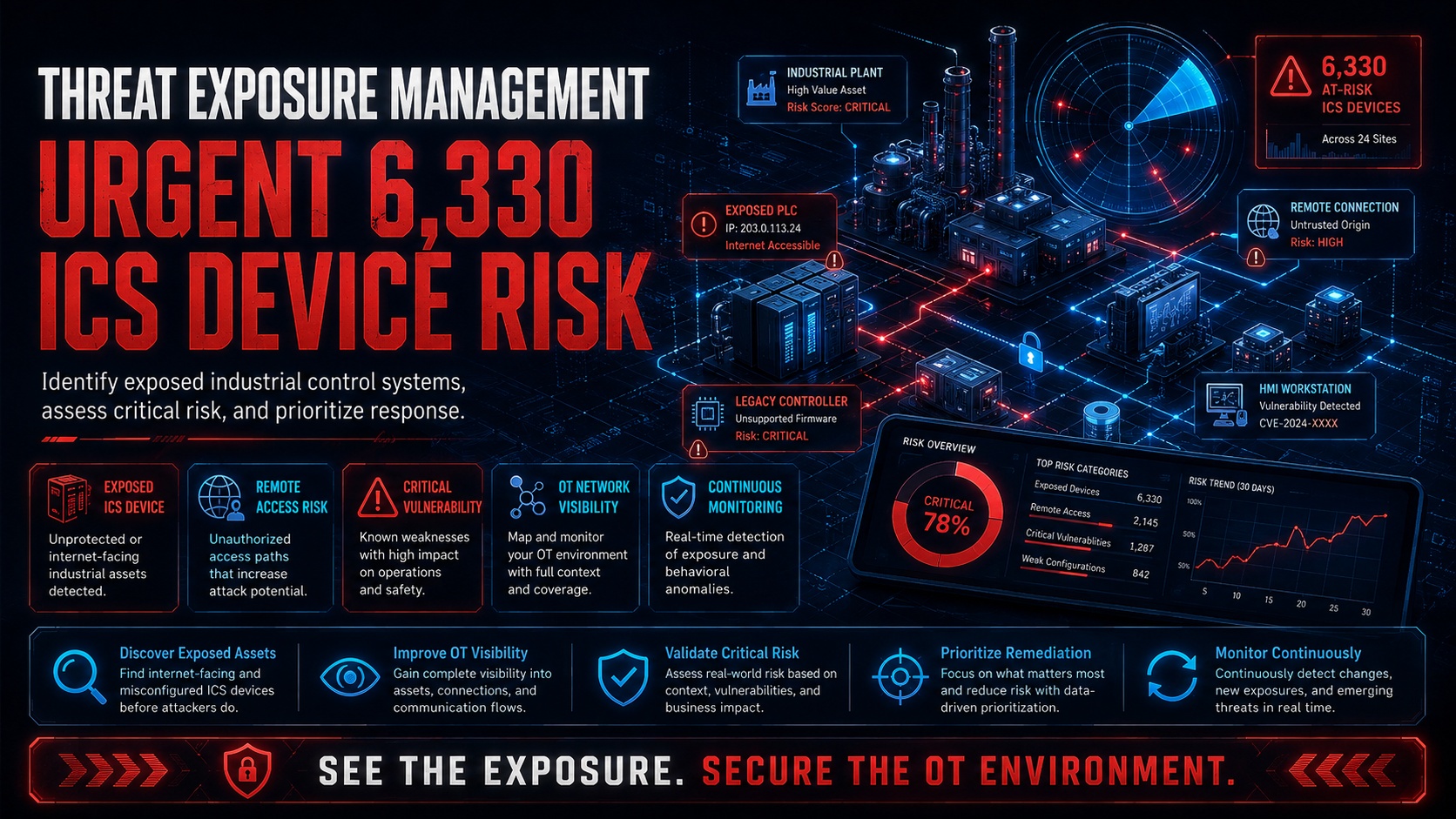
Threat exposure management is becoming increasingly important as critical operational technology moves closer to the public internet. A new report highlighted by GBHackers identifies 6,330 internet-exposed industrial control system (ICS) devices located near U.S. data centers, raising concerns about the potential impact on power, cooling, building management, and other operational systems.
The finding is particularly significant because modern data centers depend on complex operational technology to maintain temperature, electricity distribution, environmental controls, and physical infrastructure. An exposed controller does not automatically mean a facility has been compromised, but it can create an unnecessary entry point for attackers. ⚠️
For security teams, the issue is therefore bigger than vulnerability scanning. Organizations need continuous visibility into exposed assets, understand how those assets connect to critical systems, and prioritize the attack routes that could produce the greatest operational impact.
What the 6,330-device finding means
The reported number should be understood as an exposure indicator, not a count of confirmed compromises. Internet accessibility can result from misconfiguration, legacy architecture, remote administration requirements, or systems that were never intended to be publicly reachable.
ICS environments can include programmable logic controllers, supervisory control and data acquisition components, building management systems, remote terminal units, energy-management equipment, and other technologies that influence physical processes.
CISA specifically warns that organizations often leave ICS, IIoT, SCADA, and remote-access technologies exposed to the internet. Its exposure-reduction guidance recommends identifying internet-accessible assets, determining whether exposure is necessary, and restricting or removing unnecessary access.
The risk becomes more serious around data centers because availability is everything. A successful intrusion into a business application may cause data loss or downtime. An attack against an operational system could potentially interfere with environmental conditions or physical infrastructure that keeps computing equipment running. 🔥
Why exposed ICS devices are a serious data center risk
Data centers are engineered around redundancy, but redundancy does not eliminate cyber risk. Cooling, power distribution, backup systems, monitoring, and building controls are interconnected operational functions.
An attacker does not necessarily need direct control over a server to create disruption. If an exposed operational technology device provides a pathway toward a management network, credentials, or other connected systems, it could become part of a broader intrusion chain.
This is where attack path analysis becomes valuable. Rather than asking only whether an asset has a vulnerability, defenders can examine how an exposed device could connect to other systems and whether those connections lead toward high-value infrastructure.
CISA has repeatedly recommended minimizing internet exposure for control-system devices, placing control networks behind firewalls, isolating them from business networks, and using secure remote-access mechanisms when connectivity is genuinely required.
Cooling and power systems create an operational risk
Cooling is a particularly important consideration in high-density computing environments. Servers generate substantial heat, and cooling infrastructure must continuously remove that heat to maintain safe operating conditions.
Operational systems can also influence power distribution, environmental monitoring, alarms, generators, and other facility functions. A cyber incident affecting these systems could therefore create consequences that extend beyond confidentiality and into availability and physical operations.
That does not mean every exposed ICS device can shut down a data center. The actual impact depends on architecture, segmentation, authentication, device capabilities, redundancy, and the attacker’s access.
However, the exposure itself deserves investigation.
A useful security exposure assessment should therefore classify exposed systems according to both technical severity and business impact. An internet-facing controller supporting a noncritical test environment is not equivalent to an exposed device connected to a facility’s power or cooling infrastructure.
How threat exposure management helps
Traditional vulnerability management typically focuses on known weaknesses. Threat exposure management takes a broader view by examining assets, vulnerabilities, misconfigurations, identities, attack paths, and business context.
For data center operators, this means building an accurate inventory of internet-facing operational technology and determining which systems are actually exposed.
A mature program can combine:
- Internet-facing asset discovery
- ICS and OT inventory
- Vulnerability intelligence
- Configuration analysis
- Identity and credential visibility
- Network segmentation reviews
- Security exposure assessment
- Attack path analysis
- Continuous validation of remediation
The goal is not to create another massive spreadsheet of vulnerabilities. The goal is to identify which exposures represent realistic routes to important assets and fix those first. 🔎
Security exposure assessment should go beyond IP addresses
A security exposure assessment should start with a basic question: What can an attacker see from the internet?
That inventory should include known IP addresses, domains, cloud infrastructure, remote-access portals, VPN endpoints, APIs, web interfaces, and operational technology.
Organizations should also investigate assets that are not documented internally. Shadow IT, forgotten systems, vendor-managed infrastructure, and temporary deployments can all become sources of exposure.
CISA recommends routine assessments because internet-accessible assets change as organizations add systems, modify configurations, and retire infrastructure.
Domain intelligence is also relevant. Security teams researching how to find exposed subdomains should examine DNS records, certificate transparency data, historical DNS information, cloud-hosted services, and other sources that can reveal forgotten or unintended infrastructure.
Attack path analysis reveals the bigger picture
Finding an exposed device is only the first step. Attack path analysis helps determine what could happen next.
Imagine an internet-facing management interface connected to a poorly segmented operational network. That network might communicate with monitoring systems, engineering workstations, or administrative infrastructure. Each connection could potentially create another step in an intrusion.
The correct response is not to assume compromise. Instead, defenders should validate the architecture, restrict unnecessary communication, enforce strong authentication, and monitor suspicious activity.
CISA’s ICS guidance emphasizes segmentation and defense-in-depth because containing an intrusion can prevent an exposed system from becoming a bridge into more sensitive environments.
How to prevent cyber exposure in ICS environments
So, how to prevent cyber exposure when operational systems still need remote access?
The answer is controlled accessibility rather than unrestricted connectivity.
CISA recommends removing unnecessary internet exposure, changing default passwords, applying security updates, using jump hosts, monitoring traffic, and implementing multifactor authentication where possible.
Organizations should also:
- Remove direct internet access where possible. ICS devices generally should not be directly reachable from the public internet.
- Use segmentation. Separate OT networks from corporate IT and restrict communication between network zones.
- Secure remote access. Use controlled access gateways, strong authentication, and tightly managed vendor connections.
- Patch carefully. Maintain supported software and devices while considering the operational constraints of ICS environments.
- Monitor continuously. Alert on unexpected connections, configuration changes, authentication anomalies, and unusual traffic.
- Review third-party access. Vendors and contractors can introduce legitimate but potentially risky pathways into operational environments.
- Test exposure repeatedly. A secure configuration today can become exposed after a firewall change, new service deployment, or vendor update.
🛡️
Practical tip: Use an exposure checklist
Security teams can use this quick checklist as a starting point:
- Inventory every internet-facing IP, domain, subdomain, and remote-access service.
- Identify ICS, SCADA, building-management, and facility-control assets.
- Confirm whether each exposed service has a documented business requirement.
- Remove unnecessary public access.
- Place required remote services behind secure access controls.
- Verify MFA and credential protections.
- Segment OT from corporate networks.
- Review firewall rules and unnecessary ports.
- Perform security exposure assessment
- Use attack path analysis to prioritize high-impact weaknesses.
- Monitor for new infrastructure and unexpected exposure.
Organizations should also account for human risk. Security teams can use Security Awareness Software to reinforce secure remote-access practices and reduce the likelihood that employees accidentally create additional exposure through weak credentials or unsafe behavior. 📋
Domain monitoring and the wider attack surface
ICS exposure is only one part of an organization’s external risk profile. Attackers also look for domains, subdomains, cloud services, phishing infrastructure, leaked credentials, and impersonation assets.
That makes continuous domain intelligence useful alongside infrastructure security. Domain security monitoring can help organizations identify suspicious changes and external infrastructure associated with their digital footprint.
For brand and domain protection, SpoofGuard provides domain threat intelligence, lookalike-domain detection, phishing detection, and monitoring capabilities.
Security teams can also explore SpoofGuard’s technology to understand how domain permutations, certificate transparency data, threat intelligence, and other signals can be used to identify suspicious domains.
A broader external-security strategy should also consider whether stolen credentials or corporate information are being traded underground. That is where intelligence designed to protect business from dark web threats can complement attack-surface visibility.
What organizations should prioritize now
The 6,330-device figure is a reminder that internet exposure is not merely an IT problem. For organizations operating or supporting data centers, operational technology can directly influence physical availability.
A sensible priority model is:
| Priority | Exposure | Recommended action |
| Critical | Internet-facing ICS connected to power or cooling | Remove public access and investigate immediately |
| High | Remote management connected to OT networks | Restrict access, enforce MFA, review segmentation |
| Medium | Exposed legacy or unsupported systems | Isolate, patch, replace, or restrict |
| Lower | Unused internet-facing services | Decommission or block |
| This approach prevents teams from treating every finding equally. Threat exposure management works best when technical exposure is mapped to operational consequences. |
Why continuous monitoring matters
Exposure is dynamic. A device can become reachable because someone changes a firewall rule. A vendor can deploy a new remote-management service. A certificate can reveal a previously unknown subdomain. A cloud migration can introduce a new public endpoint.
For that reason, periodic penetration tests alone may not provide enough visibility.
Continuous threat exposure management can help security teams detect changes earlier and combine asset discovery with risk prioritization. When paired with regular security exposure assessment and attack path analysis, it provides a more complete view of how external weaknesses could affect critical operations.
CISA’s current exposure-reduction guidance similarly emphasizes routine assessment and monitoring rather than treating exposure as a one-time problem.
Conclusion: Treat exposed ICS as an operational security issue
The reported 6,330 internet-exposed ICS devices near U.S. data centers should be viewed as a warning about visibility and architecture—not as evidence that thousands of facilities have been compromised.
The key lesson is straightforward: an internet-facing operational device can become more than a vulnerability. Depending on its connectivity and function, it can represent a potential route toward systems that support power, cooling, monitoring, and availability.
Organizations should identify exposed assets, eliminate unnecessary internet access, segment operational networks, secure remote access, and continuously assess the routes that matter most. ⚡
Threat exposure management provides a practical framework for connecting these activities into an ongoing security program rather than relying on isolated scans.
For more guidance on reducing external exposure, consult CISA’s Internet Exposure Reduction Guidance, which recommends asset discovery, exposure validation, access restriction, and routine reassessment.
👉 Discover much more in our complete guide
👉 Request a demo NOW
Disclaimer: Threatexposure.io reports on publicly available threat-intelligence sources. Inclusion of an organization in an article does not imply confirmed compromise. All claims are attributed to external sources unless explicitly verified.
Leave a Reply